Garden sizes vary across the United Kingdom. On average, a private garden in Great Britain covers around 244 square metres, although properties in rural areas typically have much larger gardens than homes in major cities such as London1.
With such a wide range, choosing the right navigation technology determines how well a robot mower handles different terrains, obstacles, and layouts. The most common systems are RTK and LiDAR, and understanding their differences helps you pick the right one for your yard.
RTK vs LiDAR Robot Lawn Mowers: What’s the Difference?
RTK and LiDAR differ in how they guide a robot lawn mower: RTK relies on satellite signals to cut accurately; while LiDAR maps the surroundings with laser-based 3D scanning, making it easier to navigate more complex yards with trees, furniture, or pets.
What is RTK in Robotic Lawn Mower Navigation?
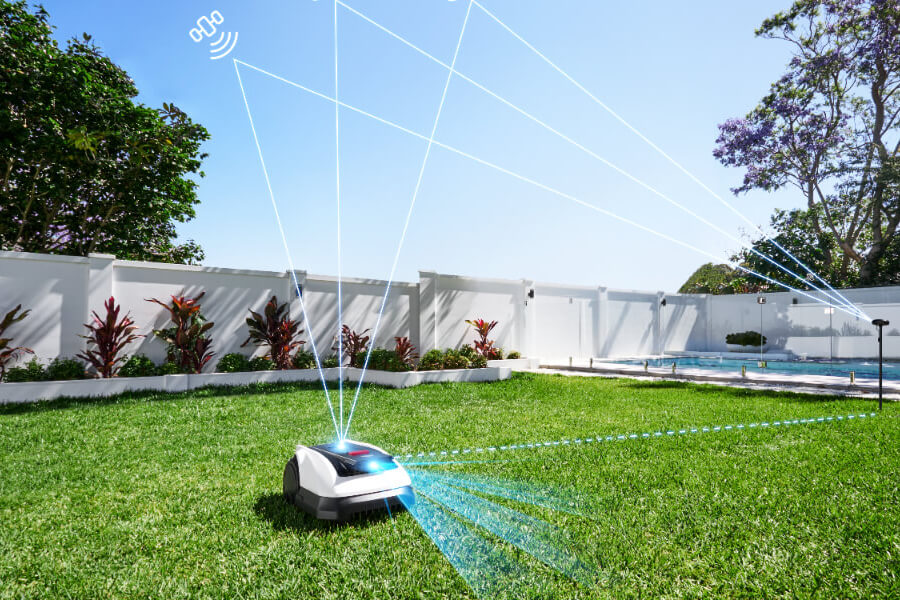
With RTK navigation, a robot lawn mower works by using global positioning satellite signals and a base station to achieve centimeter-level accuracy when exploring your lawns.
For example, the GOAT O800 RTK can receive up to 45 satellites at once.
The advantages of RTK navigation include:
- Straight-line mowing: Creates clean, uniform patterns and avoids missed areas. GOAT O800 RTK runs in a U-shaped path for 100% coverage2 both horizontally and vertically.
- Covering large area: Mow large, open lawns in structured patterns for faster coverage.
- Virtual boundaries: Defines mowing zones digitally without physical wires.
- Good for multi-zone setups: Maintains precision across different sections of a yard, even when they are separated by pathways or structures.
Yet, RTK navigation is limited in these areas:
- Satellite dependency: Loses accuracy when signals weaken or drop unexpectedly.
- Base station placement issues: Incorrect setup reduces positioning precision.
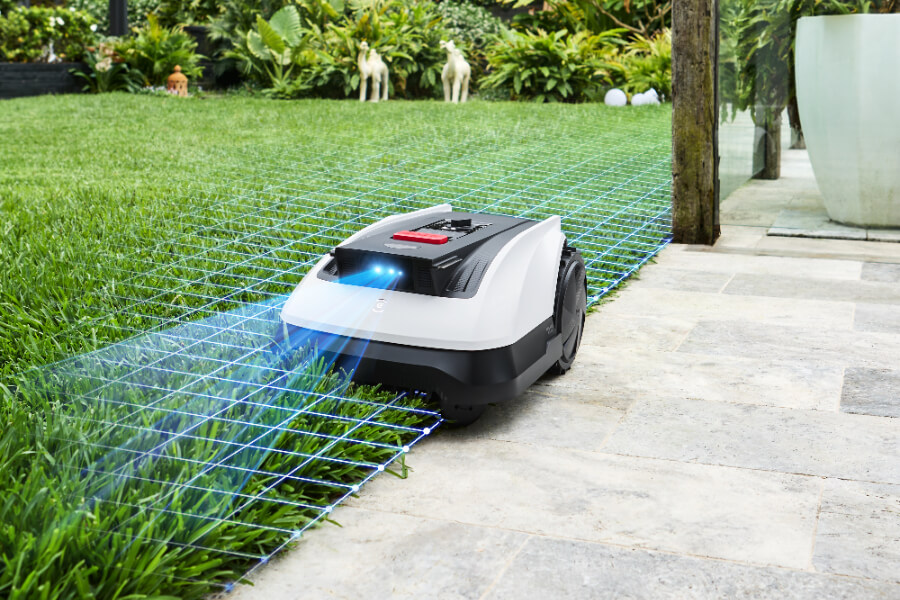
- Struggles under dense trees and buildings: Obstructions can risk interfering with satellite connectivity. GOAT O800 RTK is enhanced with a solid-state LiDAR (3D-ToF) and a fish-eye camera to minimize disturbance by shades or roofs.
- Setup considerations: Requires calibration, placement, and extra installation time.
What is LiDAR in Robot Lawn Mower Navigation?
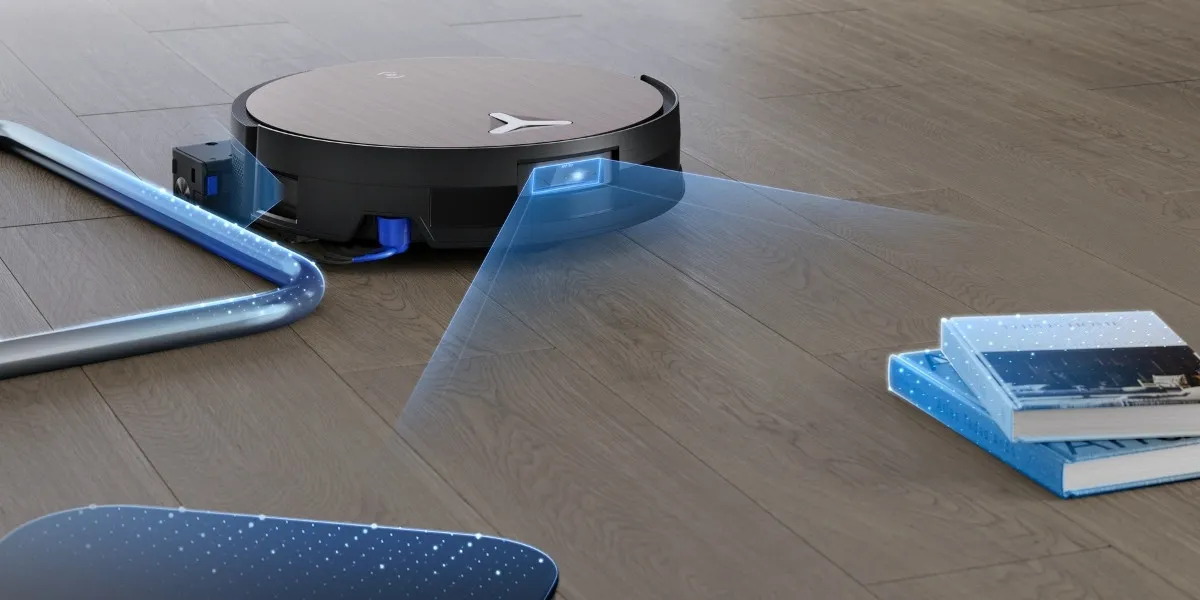
A LiDAR robot lawn mower uses laser-based mapping and real-time 3D scanning to understand its surroundings, detect obstacles and navigate complex layouts precisely, even in less optimal light conditions.
When paired with LiDAR navigation, a robot mower brings these benefits:
- Superior obstacle avoidance: Helps the robot mower mow small lawns with clutter safely.
- Complex layouts: Handles tight spaces and irregular shapes with accuracy.
- Cluttered yards: Detects trees, toys, small animals, and furniture in real time.
- Works in the dark: Maintains full navigation accuracy without daylight.
- Easy set up: No extra base station or setup required.
However, LiDAR navigation also comes with a few drawbacks:
- Higher cost: Advanced hardware increases overall mower pricing.
- Weather sensitivity: Fog and heavy rain may scatter and absorb laser beams, impacting laser performance.
RTK vs LiDAR Robot Mowers: What’s the Best Choice For You?
The best choice depends on your yard’s needs. Typically, RTK performs better on taking straight, efficient paths on large, open lawns, while LiDAR offers superior mapping and obstacle detection for complex or shaded yards.
Here’s how to choose a robot lawn mower based on common yard scenarios:
- Small yards: LiDAR works better for navigating around narrow and irregular paths commonly seen in small gardens.
- Large open lawns: RTK provides systematic coverage, precise straight lines, and reliable performance over spacious, uninterrupted spaces.
- Obstacles, trees, and irregular layouts: LiDAR handles cluttered layouts, shaded zones, and unpredictable obstacles well thanks to 3D scanning in real time.
- Multi-Zone or Hard-to-Reach Areas: Both work, but LiDAR handles transitions and boundary detection more flexibly without depending on satellite signals.
Here’s a quick table that compares both navigation technologies:
|
Feature |
RTK Navigation |
LiDAR Navigation |
|
Accuracy |
Centimeter-level precision using satellite correction |
High accuracy through 3D laser mapping |
|
Obstacle Avoidance |
Basic detection depending on model |
Excellent real-time avoidance |
|
Installation Difficulty |
Moderate; requires base station |
Easy; no satellite setup required |
|
Lawn Size Suitability |
Best for large, open areas |
Best for small to medium, complex yards |
|
Terrain Handling |
Works well on flat, open spaces |
Great for uneven layouts and mixed terrain |
|
Reliability Under Trees/Buildings |
Struggles with signal loss |
Unaffected by shade or structures |
|
Night Mowing |
Works, but satellite shading may affect accuracy |
Performs reliably even in complete darkness |
|
Cost Category |
Typically more affordable |
Usually higher due to advanced sensors |
Accuracy
RTK is effective for covering large lawns with systematic paths, but may lose precision near tall structures. LiDAR, on the other hand, scans surroundings in real time, ensuring consistent navigation even when cutting grass along the edge of fences or garden beds.
Obstacle Avoidance
RTK relies more on preset boundaries and basic sensors, while LiDAR actively detects objects like furniture and trees, helping the mower adapt instantly to movement or unexpected obstacles.
Installation Difficulty
To install a robot lawn mower with RTK, you need to set up a base station in an open, unobstructed area. LiDAR models skip this step and have no specific placement rules.
Lawn Size Suitability
For large open yards, RTK is better at ensuring full, accurate coverage. If your backyard has irregular terrain or narrow paths, LiDAR is more effective with real-time 3D scanning.
Terrain Handling
While RTK handles open level surfaces well, LiDAR performs better on uneven mixed terrain. Its precise scanning helps a robot mower climb hills and avoid rough patches more intelligently.
Reliability
If your lawn is heavily shaded by tree canopies or between buildings, be aware that RTK accuracy may drop due to satellite signal interference. Still, LiDAR remains consistent thanks to laser sensing.
Night Mowing
Both RTK and LiDAR perform reliably in darkness because satellite signals or LiDAR sensors do not rely on daylight. Plus, most robot mowers run quietly and cause minimal disturbance to your neighbours.
Cost Category
RTK models are generally more budget-friendly than LiDAR ones, as the advanced sensors and software development drive up the costs. If you find the right model, robot lawn mowers are worth the investment for advanced navigation.
FAQ
Can robot mowers use both RTK and LiDAR?
Yes, some robot mowers combine RTK with LiDAR to improve accuracy and stability. An example is the GOAT O800 RTK with LiDAR-Enhanced RTK Navigation, which helps the robot navigate stably when satellite signals are shielded under heavy shade or roofs.
Can a robot mower navigate without physical wires?
Yes, many robot mowers can navigate without physical boundary wires. Whether it is RTK or LiDAR, these systems map the yard and create virtual boundaries to guide the mower.
Do robot mowers work in the rain?
While models like GOAT robot mowers are IPX6 waterproof, it is not recommended to cut wet grass as it may risk uneven cuts.
Disclaimer(s):
- Average yard sizes in the UK: https://www.rhs.org.uk/press/releases/first-ever-ai-mapping-of-uk%E2%80%99s-growing-spaces-r-(1)
- 100% coverage: This refers to the full coverage of the claimed lawn area by ECOVACS GOAT, measured by ECOVACS Laboratory. For detailed area information, please kindly find it in product spec. Actual results may vary depending on factors such as grass type, terrain, and other environmental conditions.